
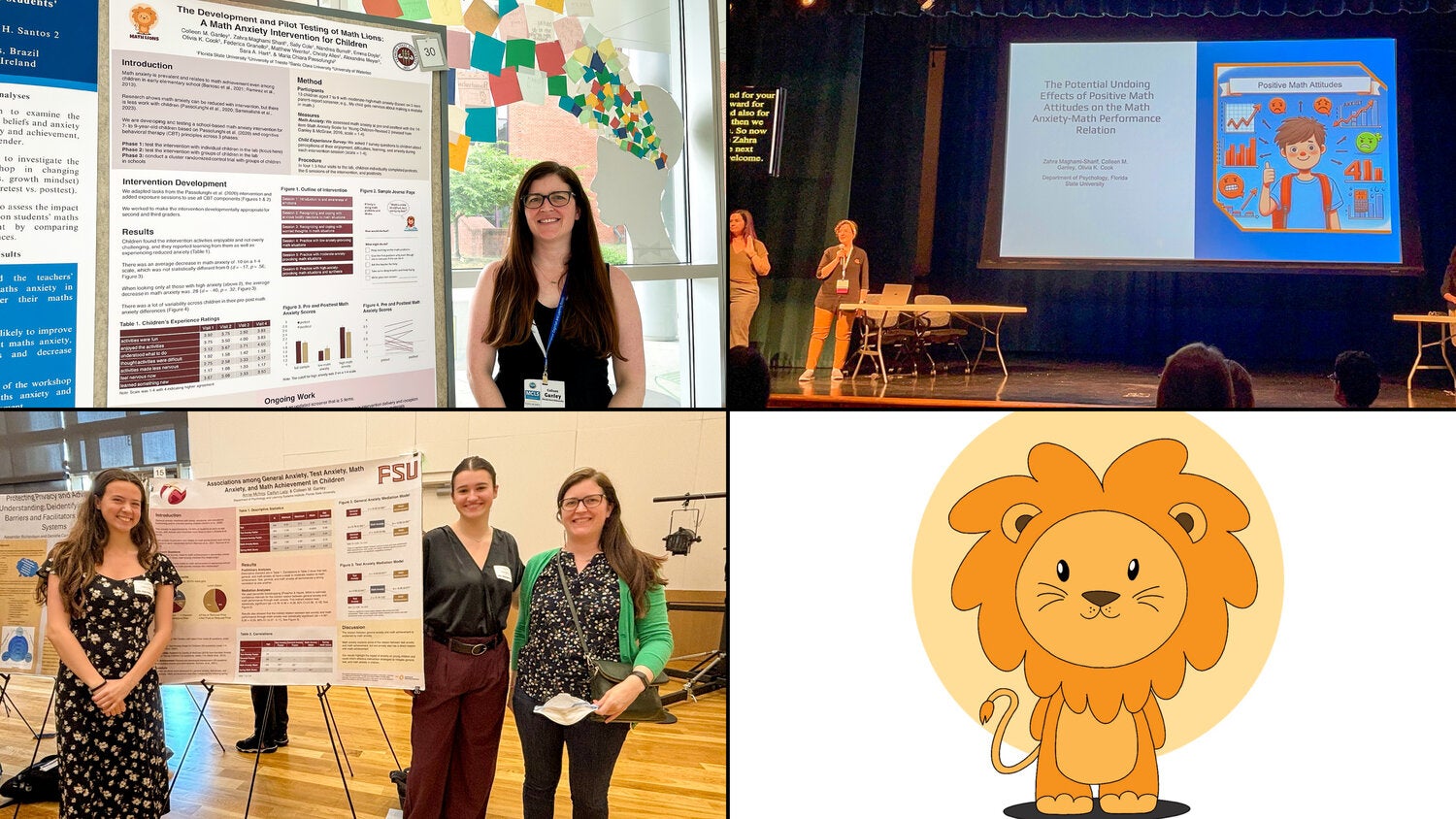
Examining the Mechanisms of the Math Anxiety-Math Achievement Link through a School-Based Grades 2-3 Intervention
Funding Partner: National Science Foundation
Principal Investigator: Dr. Colleen Ganley
Project Announcement
In May of 2022, LSI was awarded a three-year grant from the National Science Foundation (NSF) in the amount of $1,498,140 to develop a school-based intervention for children with math anxiety using strategies from cognitive behavioral therapy. The project, titled “Examining the Mechanisms of the Math Anxiety-Math Achievement Link through a School-Based Grades 2-3 Intervention,” is supported by the NSF’s Education and Human Resources (EHR) Core Research (ECR) program. The ECR program emphasizes fundamental science, technology, engineering and mathematics (STEM) education research that generates foundational knowledge in the field.
“A lot of people experience math anxiety, and it can develop in really young children and persist as they get older,” said principal investigator and FSU Associate Professor of Developmental Psychology Dr. Colleen Ganley. “Unfortunately, people with math anxiety tend to have a harder time with math and are less likely to take higher-level math courses or pursue STEM careers. We wanted to address math anxiety early so we could decrease the chances of negative educational impacts later in life.”
The first goal of the project is to develop the math anxiety intervention. The researchers will adapt an existing classroom-based intervention and add exposure components from cognitive behavioral therapy interventions. Exposure has been found to decrease anxiety for children with other anxiety-related disorders. Through the development process, they will create a child intervention workbook, facilitator session guides, and facilitator training materials. They will try out these intervention materials with children to find ways to improve them.
The second goal is to test if the intervention decreases math anxiety and if changes in math anxiety relate to increases in working memory and decreases in the avoidance of math, which relate to later improvements in math skills. Half of the children in the study will participate in the small-group intervention and half will not. The researchers will compare the math anxiety in the children who participate in the intervention to those who do not to see if there are more significant decreases for the children who got the intervention. They will also test to see improvements in math achievement and if those improvements happen because of changes in working memory and math avoidance. Once the project is complete, the researchers will make any other necessary changes to the intervention materials and then share the materials to be used by researchers and school personnel.
“This research will contribute to our understanding of how math anxiety and math achievement are related, as well as whether this intervention can decrease math anxiety and improve student math learning,” said Dr. Ganley. “This intervention, if found effective, has the potential to lead to long-term improvements in math learning for children with math anxiety and can help make their math learning a more positive experience.”
This research is in collaboration with Dr. Alexandria Meyer, who is an Associate Professor of Clinical Psychology at FSU, Dr. Sara Hart, who is Professor and W. Russell and Eugenia Morcom Chair in Developmental Psychology and the Florida Center for Reading Research at FSU and Dr. Maria Chiara Passolunghi, Professor of Developmental and Educational Psychology at University of Trieste, Italy.
The Learning Systems Institute (LSI) at Florida State University is at the forefront of developing innovative solutions that bridge theory and practice in education. Our experts' advanced research not only provides state-of-the-art methods but also a clear path for implementation. For more than 50 years, LSI has delivered systems that measurably improve the learning and performance of organizations and individuals here in Florida and across the world.
2024 Update
This was the second year of the Math Lions project, funded by the National Science Foundation. The aims of this project are to 1) develop materials for a math anxiety intervention for children, 2) test the intervention’s effect on math anxiety in a cluster randomized trial in schools, and 3) see whether there are subsequent effects on working memory, math avoidance, and then math achievement.
During this past year, we engaged in an iterative development and testing process for intervention materials including facilitator training materials, a child journal and a facilitator guide. We tested the intervention with 13 individual children in the lab and 7 children in groups. We then revised the materials based on what we learned, and recruited and implemented the intervention within 4 public elementary schools in a cluster randomized trial.
2025 Update
This was the third year of the Math Lions project, funded by the National Science Foundation. The aims of this project are to 1) develop materials for a math anxiety intervention for children, 2) test the intervention’s effect on math anxiety in a cluster randomized trial in schools, and 3) see whether there are subsequent effects on working memory, math avoidance, and then math achievement.
During this past year, staff continued testing the efficacy of the Math Lions math anxiety intervention through a cluster randomized trial in 11 elementary schools. During the past year, 71 children with math anxiety participated in the Math Lions intervention to help reduce their math anxiety. This brings the total number of children who have been in the intervention to 131 over the full course of the project.
2026 Update - Final Year of Project
This was the final year of the Math Lions project, funded by the National Science Foundation. The aims of this project were to 1) develop materials for a math anxiety intervention for children, 2) test the intervention's effect on math anxiety in a cluster randomized trial in schools, and 3) see whether there are subsequent effects on working memory, math avoidance, and then math achievement.
Our team first developed the Math Lions intervention by working with collaborators in Italy and our advisory board to develop training materials, a facilitator guide, and child workbooks. They then tested the intervention with 13 individual children and 7 children in groups in the lab and revised the materials based on what we learned. We used these revised intervention materials in a cluster randomized trial across 11 elementary schools and spanning 3 cohorts from 2024-2026 we worked with 208 students, of whom 110 received the intervention and 98 served as a control group.
Pilot findings suggest substantial variability across children in their responses to the intervention. Final analyses for the cluster randomized trial are not yet complete, but evidence suggests children enjoyed and learned in the intervention, and it was implemented with fidelity. Data collection is now complete, and the final dataset is being prepared for analysis and public sharing.