BridgeUSA Ukraine Program for Resilience and Reconstruction (UPRR)
Funding Partner: U.S. Embassy in Kyiv
Principal Investigator: Dr. Vilma Fuentes
2024
July 1, 2024
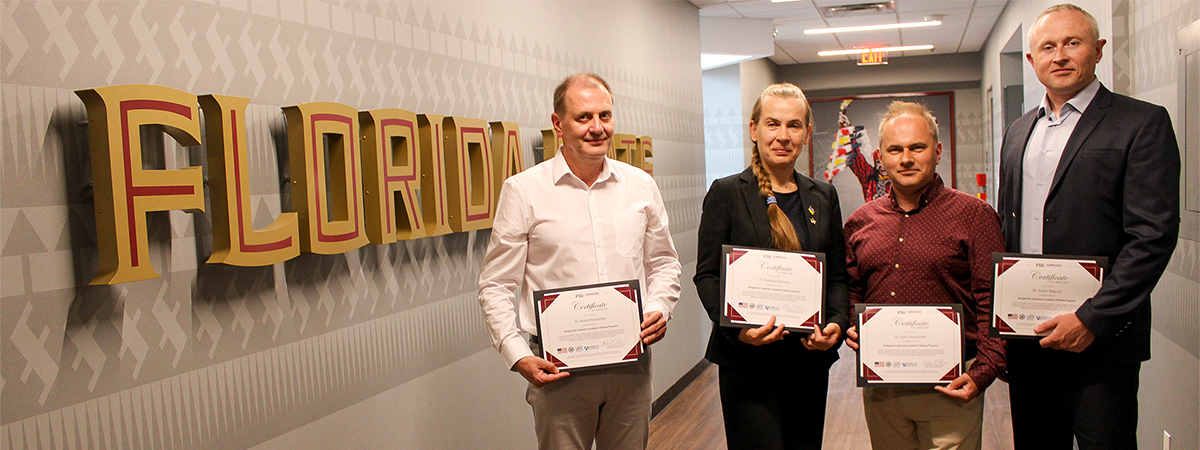
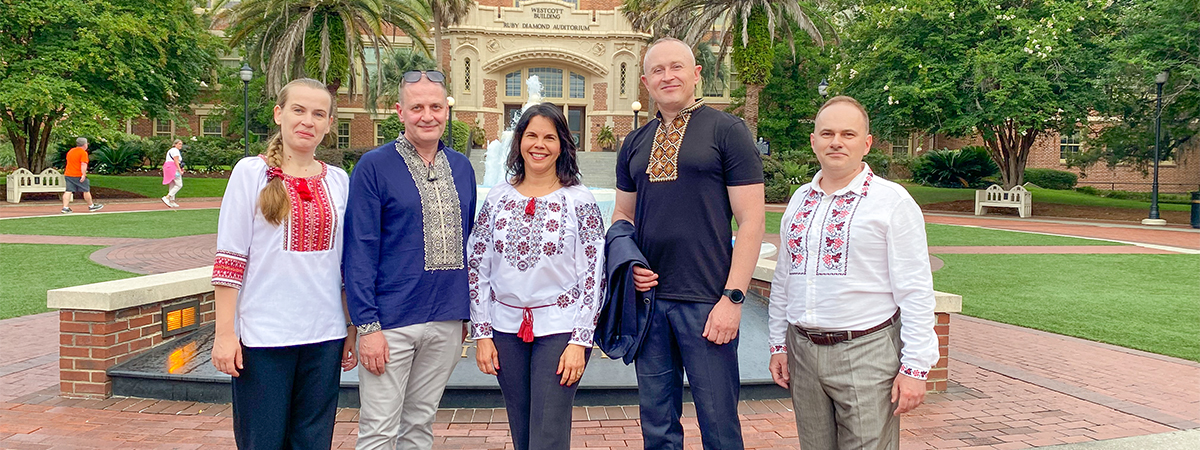
Florida State University is hosting four academic fellows from Ukraine for a monthlong visit through the BridgeUSA Ukrainian Academic Fellows Program (BridgeUSA UAFP). FSU is the first university in the United States to host fellows through the program.
The fellows will work with faculty mentors at FSU to develop individualized, collaborative programs that meet their specific needs as researchers and educators seeking to strengthen Ukraine’s capacity to rebuild. The program runs June 25 through July 25.
Their visit marks another significant move by FSU’s Ukraine Task Force (UTF), which continues to forge partnerships between FSU and Ukrainian scholars and educate the FSU community about Ukraine. The task force was established in 2022 and falls under the Learning Systems Institute (LSI) at FSU.
“It is easy for us to forget the trauma and challenges of war,” said Vilma Fuentes, program director of FSU’s UTF. “We are spectators, looking at this tragedy unfold from afar. Having the ability to speak to Ukrainians who are fighting for freedom and independence against all odds is a humbling experience. It is a privilege to stand by their side and express our support and collaboration.”
The BridgeUSA UAFP builds links between Ukrainian and U.S. scholars for long-term collaboration in areas like joint research, shared pedagogy, course development and publication. The program’s long-term goal is to help Ukrainian universities educate and train professionals critical to the country’s recovery and reconstruction through lasting, productive collaboration with U.S. institutions of higher education.
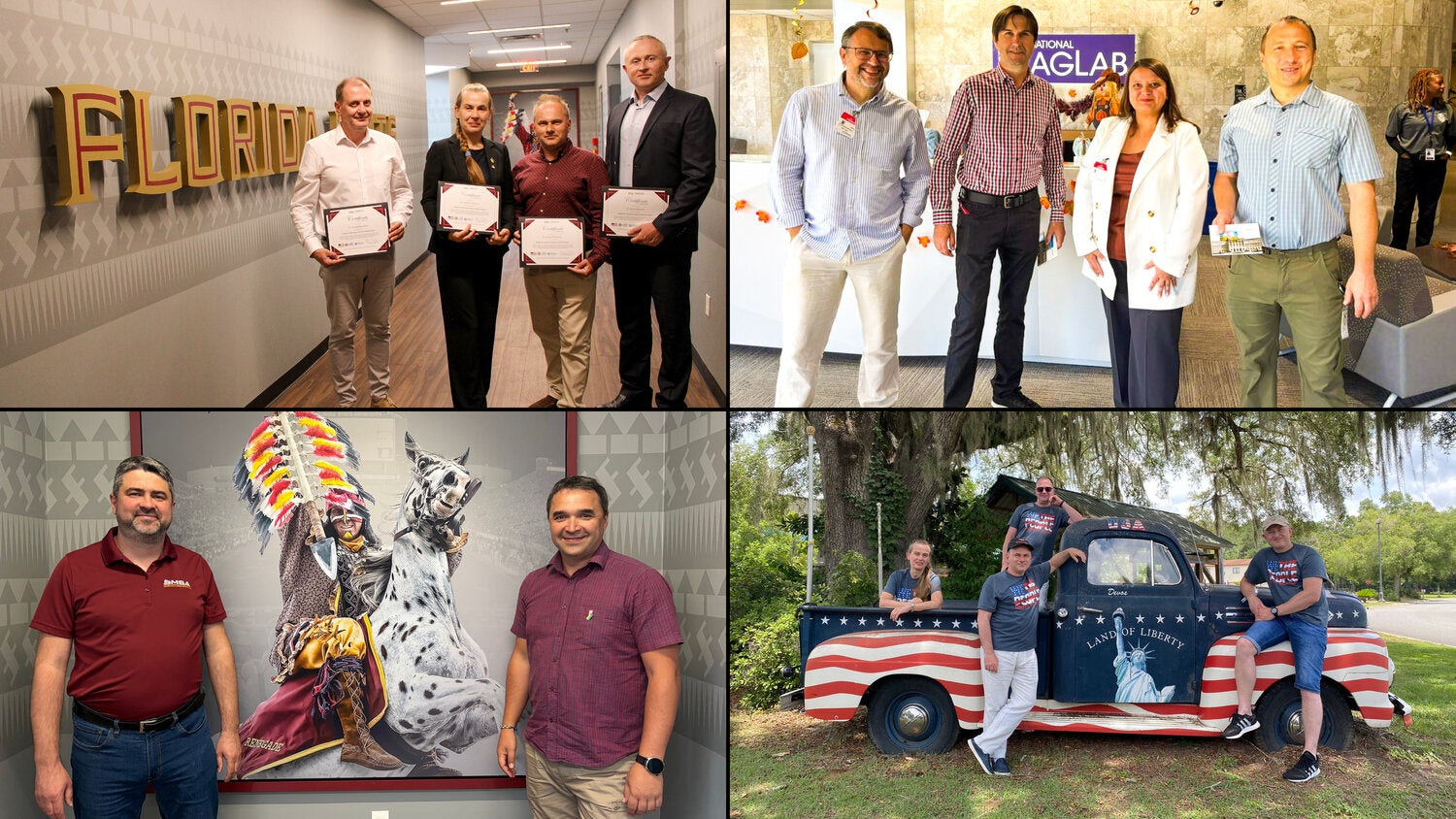
The four 2024 BridgeUSA UAFP Fellows hosted by FSU are Taras Panchenko, Andrii Balandr, Andrii Rokalda and Natalia Safonova.
Panchenko is the head of the computer science department at Taras Shevchenko National University in Kyiv, Ukraine. His scientific interests include cybersecurity, artificial intelligence, computer science and information technologies. During his visit to FSU, Panchenko is looking forward to collaborating with Information Technology Services at FSU and learning more about drone assisted damage assessment.
“I hope we will be able to share our teaching experience during the lectures with students, and also we can help our American colleagues understand how to survive in such a hard situation as Ukraine lives now — without electricity, internet, under missile attacks — while trying not to lose the quality of education,” Panchenko said.
Balandr is the head of the Language Training and Testing Center at Bhodan Khmelnytskyy National Academy of the State Border Guard Service of Ukraine in Khmelnytskyi. A colonel deployed to active combat in Eastern Ukraine in 2023, Balandr wants to develop a textbook for Ukranian border guards using content-based English instruction.
“I’m here to gain as much as possible from the leading higher education American experience,” Balandr said. “I’m mostly interested in the work of LSI and their many years of experience creating and designing educational curriculum through methodological provision; we are going to adapt and tailor the acquired experience to the needs of the target population in Ukraine.”
Rokalda is the head of the Digital Economy and Systems Analysis Department at the State University of Trade and Economics in Kyiv, Ukraine. With a Ph.D. in applied mathematics, he wants to improve the quality and security of online education in Ukraine. His academic areas of interest include data analytics, business analytics, business intelligence tools and mathematical modeling.
“During the next month, I want to get information about the training of students in the U.S. and learn new approaches for teaching students, organizing education, and scientific works while also sharing my scientific experience with American students,” Rokalda said. “I’m excited about the exchange of experiences with colleagues regarding joint-development of new programs and courses and joint-publication of scientific articles.”
Safonova is the head of the Department of English Philology at Oles Honchar Dnipro National University in Dnipro, Ukraine. A teacher of English and TESOL (Teaching English to Speakers of Other Languages), she looks forward to learning innovative pedagogical techniques from the Center for the Advancement of Teaching at FSU to improve curriculum and syllabi for teacher preparation and incorporate social and emotional learning into her classes.
“I am interested in developing teaching methods of English in connection with English and Ukranian literature and culture,” Safonova said. “I would like to create interest in Ukranian culture and literature with the professors of FSU that I will be working with. We could have some joint research about the influence of Ukranian/English literature and teaching English in a multicultural context, particularly teaching in emergencies as is the experience in Ukraine.”
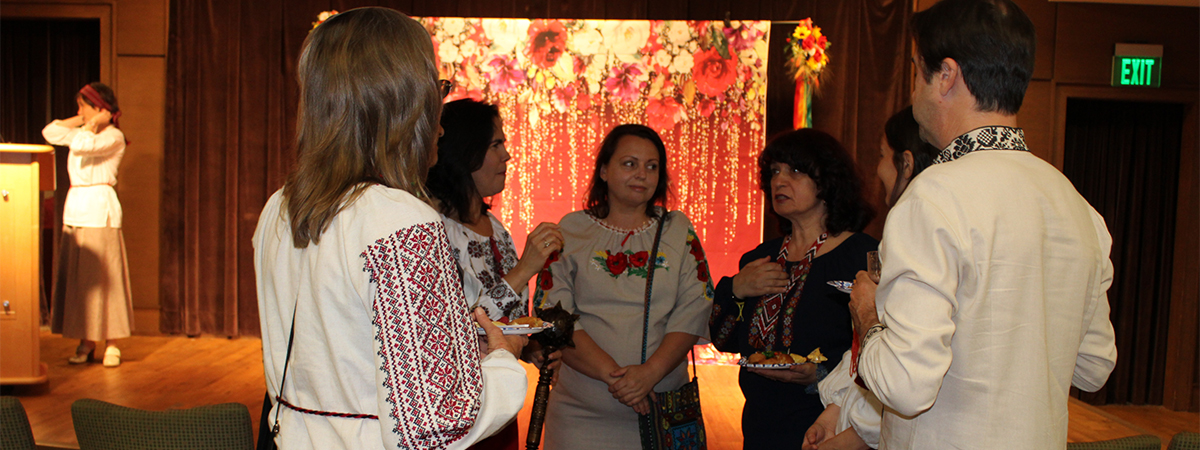
Throughout their month-long stay at FSU, the BridgeUSA UAFP fellows will participate in International Coffee Hour, the Center for Global Engagement’s (CGE) signature social event, at 5 p.m. Friday, July 12, at The Globe. The fellows will also participate in a panel discussion hosted by the CGE at 6 p.m. Wednesday, July 17, at The Globe Auditorium.
“I am extremely excited by the welcomeness of Vilma (Fuentes) and the Ukrainian Task Force,” Panchenko said. “The effort her and her colleagues put into our group, to support us and help us in any way, is just unbelievable. The openness of people and the huge attention has been so good; they really would like to help us and to improve our communications during our stay at the university.”
2025
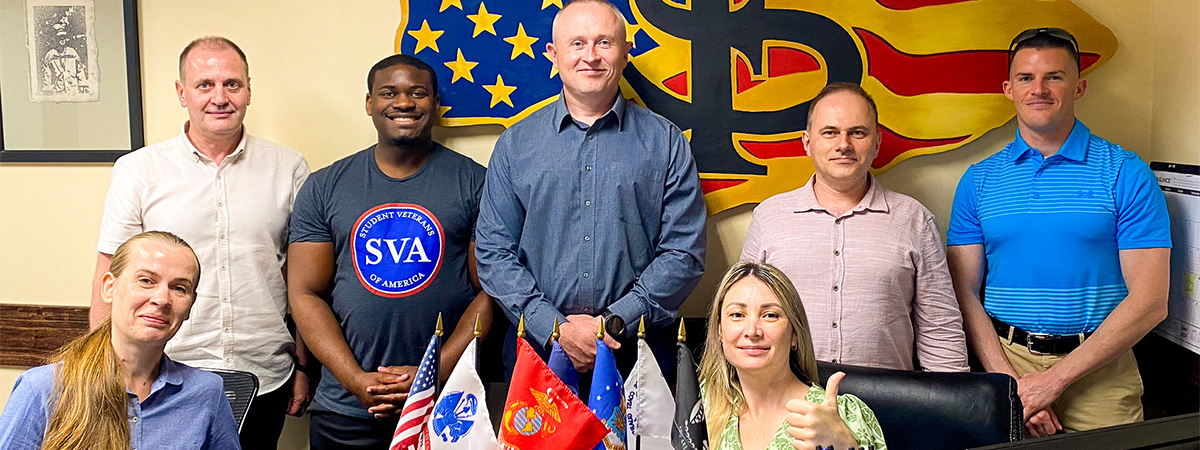
This past month, two Ukrainian scholars spent four weeks at Florida State University, sharing lessons learned from a war-torn country and building relationships for shared research projects. The exchange is part of the BridgeUSA Ukraine Program for Resilience and Reconstruction (UPRR), which connects Ukrainian and U.S. scholars for collaborative research, education development and knowledge sharing.
BridgeUSA is funded by the U.S. Department of State and the U.S. Embassy in Kyiv and administered by the American Councils for International Education. This is the second year that the Ukraine Task Force (UTF), housed at the Learning Systems Institute (LSI), has hosted fellows from the program. Dr. Vilma Fuentes is the director of the UTF.
"We are thankful to the U.S. Embassy Kyiv and the American Councils for International Education for making these academic exchanges possible," said Fuentes. "We were honored to have hosted Dr. Sofiia Doskich and Dr. Kostyantyn Mezentsev and to have facilitated these new and growing engagements with Ukrainian academic partners."
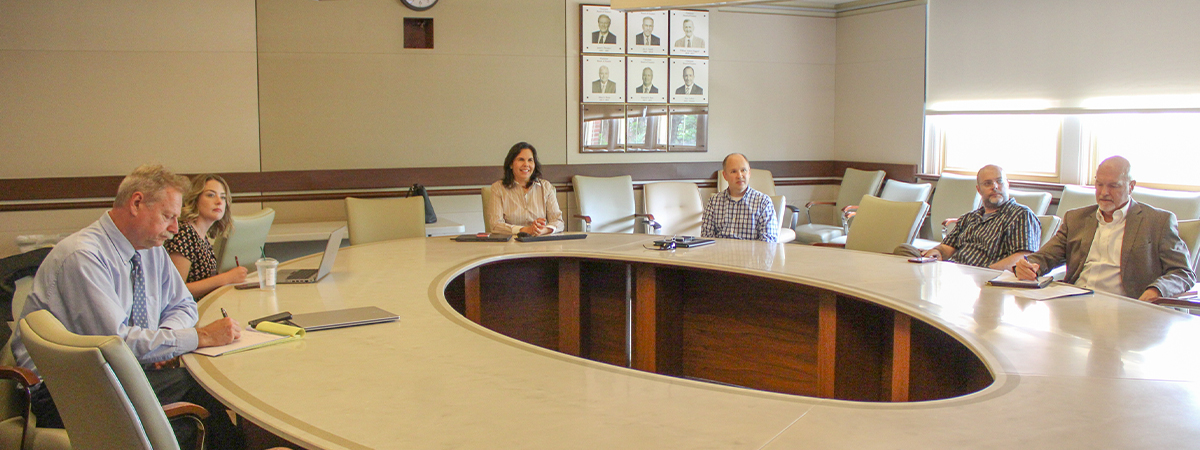
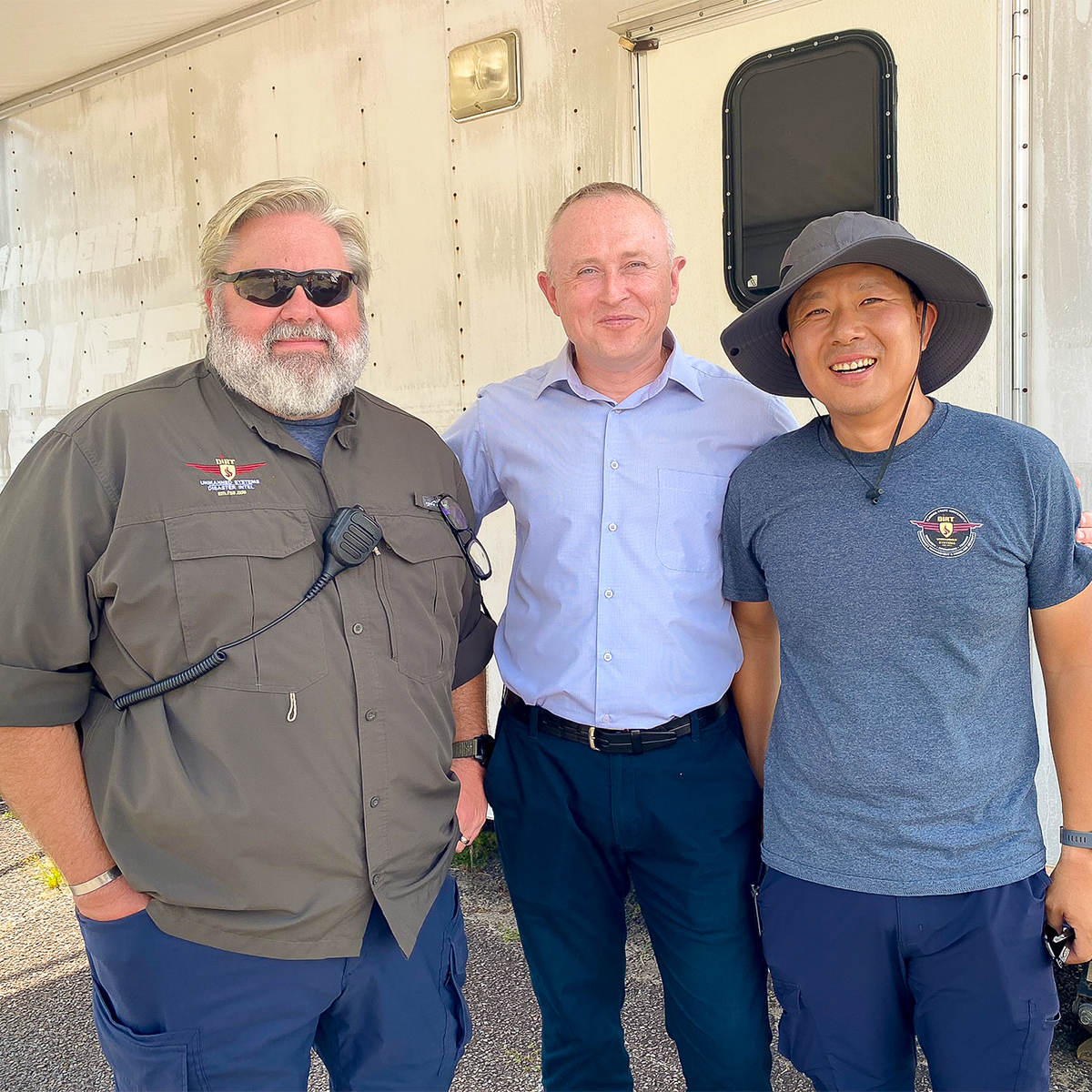
The knowledge exchange between Dr. Doskich, Dr. Mezentsev and FSU faculty and staff centered on numerous areas, including emergency management, homeland security, urban planning, drone applications, engineering, geography and the reconstruction of urban regions after disasters. The meetings generated a number of areas for research collaborations and partnerships.
"First of all, we have experience that American researchers don't have, which allowed us to build databases from the frontline," said Doskich. "We have nearly 80 GPS stations across Ukraine providing very valuable data that both Ukrainian and American researchers can use. We have research on the critical infrastructure of Ukraine and our use of remote sensing techniques. We have technology to improve satellite image detections, so we can share our knowledge in these areas as well."
Mezentsev, who is a professor, head of department and member of the Academic Senate at Taras Shevchenko National University of Kyiv, focuses his research on urban geopolitics, urbicide, urban regeneration and urban resilience. His work, focusing on rebuilding Ukraine's cities after the Russian invasion, struck a chord with numerous faculty members at FSU.
"Let's look at what the impact is on cities through the lens of any disturbance, any disaster for a city," said Mezentsev. "It could happen anywhere. Tornadoes or hurricanes. Consider evacuation or seeking shelter in the event of a bomb threat. It's the same way we think about the impact of any external disaster. I asked a group 'How many of you evacuated during the last hurricane.' Who stayed at home? What does it mean for your city?"
BridgeUSA aims to foster partnerships between universities. The program equips professionals with the skills and expertise needed to support Ukraine's recovery and resilience but it also provides host universities with the opportunity to gain insight into valuable research learned firsthand during a time of unspeakable violence and destruction.
"This is not just about us needing assistance and our country being in pain," said Mezentsev. "We can also exchange information. I'm participating in the BridgeUSA program and it's a bridge for both sides, not just one way. It's for both sides to make this bridge more stable."
"I came to find collaboration, to share knowledge and research, and this will be very helpful for us, for our country, for other scientists, for other researchers and for other educators," said Doskich. "It's good to have someone who can look at your research from another direction and maybe notice some things that they can see from other perspectives."
LSI strives to lead the way in creating innovative educational solutions that seamlessly connect theory with practice. Through advanced research, we develop industry-leading methods and implementation strategies to enhance systematic learning at all levels and in all environments. For more than five decades, LSI has been committed to driving measurable improvements in the performance of both individuals and organizations.
2026
The Learning System Institute (LSI) at Florida State University (FSU) hosted its third group of fellows as part of the Bridge USA Ukraine Program for Resilience and Reconstruction (UPRR). Through this program, Ukrainian and U.S. scholars connect to foster research, develop education and rebuild resilience through international partnerships.
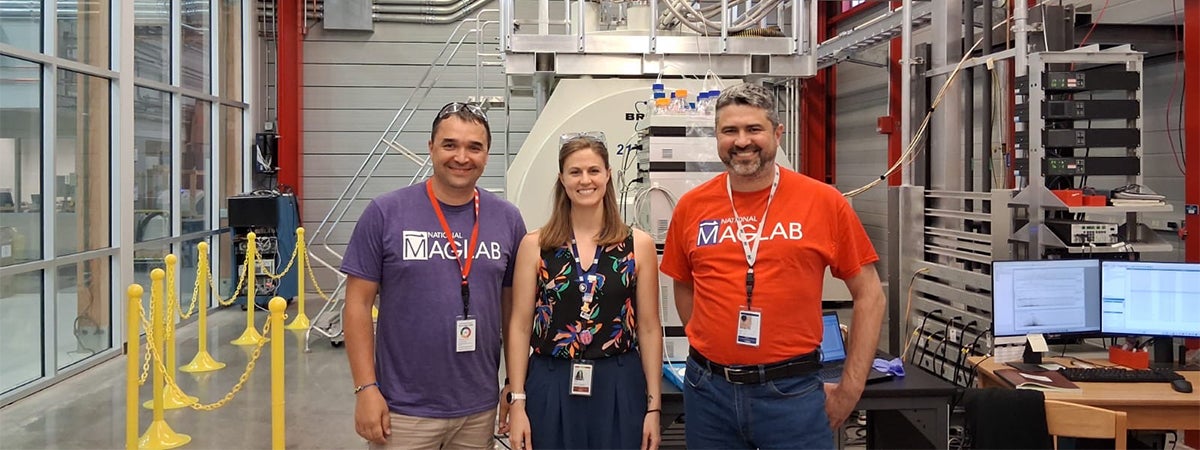
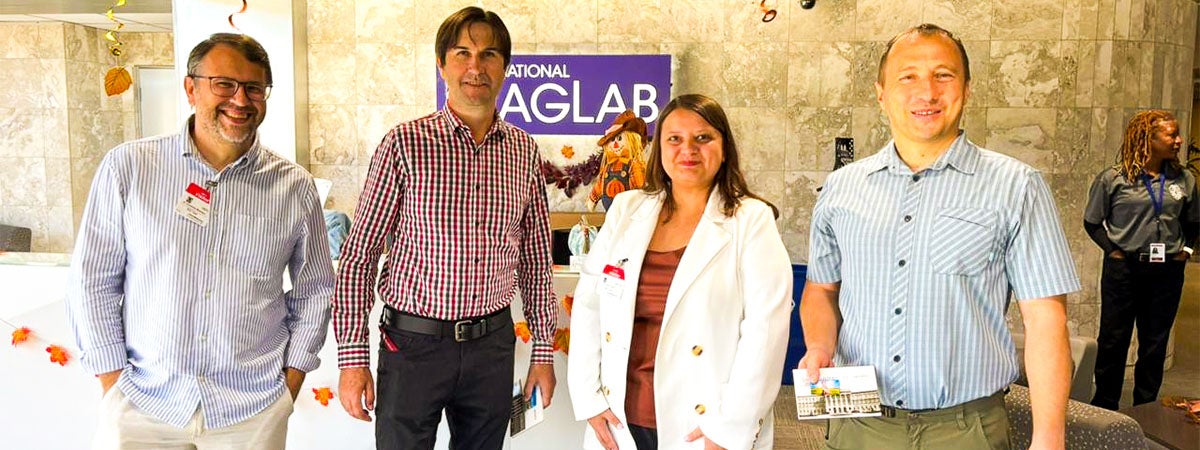
FSU’s Ukraine Task Force (UTF) hosted Dmytro Diadin, Ph.D., and Oleksandra Hrytstna, Ph.D., for four weeks of research collaboration and relationship-building between academicians, as researchers from FSU continue exploring joint ventures to strengthen FSU’s fundamental science research.
“While staying here, we were really in good hands,” said Diadin. “We really appreciate the efforts. We are very grateful to them (FSU’s UTF) for hosting us because this ensures that we will go to Ukraine with really tangible outcomes, tangible results.”
Both Diadin and Hrytstna worked directly with FSU’s High Magnetic Field Laboratory staff to examine and consult on groundwater samples sent from Ukraine. The researchers are looking at the effects of the ongoing Russian invasion on the country’s water.
“The most exciting and the most useful part for me was taking samples (of Ukrainian groundwater) and using the magnificent capabilities of the Mag Lab to analyze this water,” said Diadin. “This is actually the first time ever that Ukrainian water was analyzed on such magnetic instruments. So, this is the only place in the world where we can do it with such precision.”
The opportunities for FSU scientists to work with Ukrainians are plentiful due to Florida's geology, particularly in North Florida, which is home to more than 300 documented freshwater springs.
“I see a beautiful harmony here,” said Hrytstna. “It is a unique ecosystem in Florida, in Tallahassee. How FSU built a world-class academic campus right inside this natural paradise shows me that progress and nature can live together.”
“I see that we will have further cooperation on water quality and just in general water studies because in Florida you have really unique conditions of groundwater formation, groundwater pollution and groundwater use,” added Diadin. “In Ukraine we have different conditions but the impacts, the anthropogenic inputs to water and the necessity of water preservation, to ensure water quality, water safety. This is in our common tasks. So, I really see that we will cooperate on these water issues with the FSU.”
The BridgeUSA Ukraine Program for Resilience and Reconstruction is funded by the U.S. Embassy in Kyiv, with additional funding from U.S. host institutions, and is administered by American Councils for International Education. The program equips professionals with the skills and expertise needed to support Ukraine’s recovery and resilience.
“BridgeUSA provides an opportunity to meet face-to-face,” said Hrytstna. “It is important because you see your partner, your scientist colleagues and you have eye contact. In a face-to-face meeting, we can better understand each other. For me, it is a two-way bridge. It is not only the U.S. to Ukraine. It is also Ukraine to the U.S.”