
LSI Continues Partnership with American Councils Hosting Third Group of Ukrainian Fellows
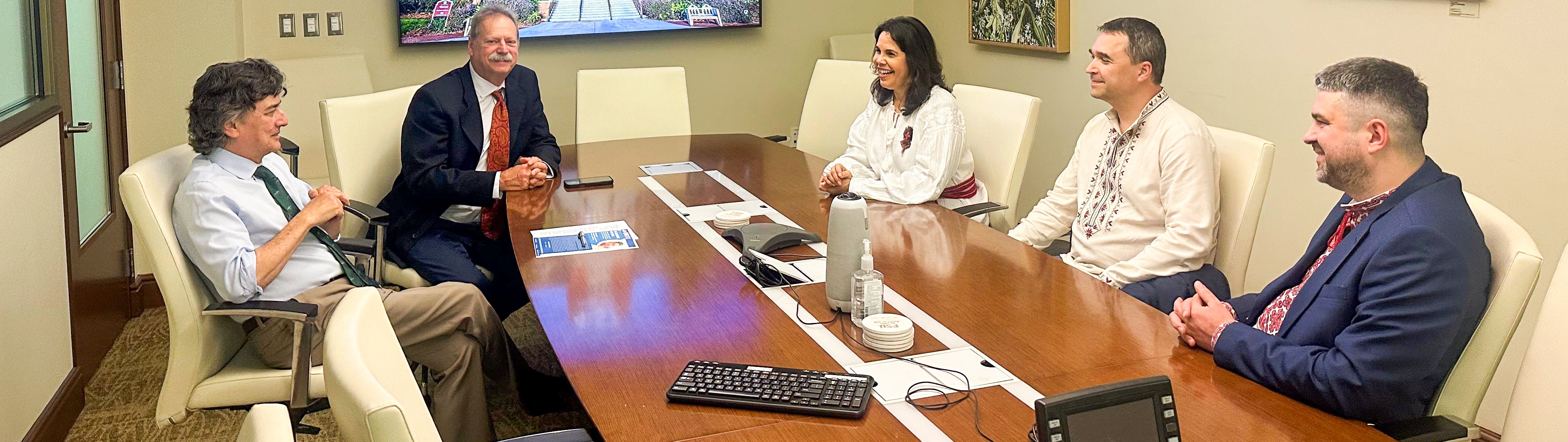
The Learning System Institute (LSI) at Florida State University (FSU) hosted its third group of fellows as part of the Bridge USA Ukraine Program for Resilience and Reconstruction (UPRR). Through this program, Ukrainian and U.S. scholars connect to foster research, develop education and rebuild resilience through international partnerships.
FSU’s Ukraine Task Force (UTF) hosted Dmytro Diadin, Ph.D., and Oleksandra Hrytstna, Ph.D., for four weeks of research collaboration and relationship-building between academicians, as researchers from FSU continue exploring joint ventures to strengthen FSU’s fundamental science research.
“While staying here, we were really in good hands,” said Diadin. “We really appreciate the efforts. We are very grateful to them (FSU’s UTF) for hosting us because this ensures that we will go to Ukraine with really tangible outcomes, tangible results.”
Both Diadin and Hrytstna worked directly with FSU’s High Magnetic Field Laboratory staff to examine and consult on groundwater samples sent from Ukraine. The researchers are looking at the effects of the ongoing Russian invasion on the country’s water.
“The most exciting and the most useful part for me was taking samples (of Ukrainian groundwater) and using the magnificent capabilities of the Mag Lab to analyze this water,” said Diadin. “This is actually the first time ever that Ukrainian water was analyzed on such magnetic instruments. So, this is the only place in the world where we can do it with such precision.”
The opportunities for FSU scientists to work with Ukrainians are plentiful due to Florida's geology, particularly in North Florida, which is home to more than 300 documented freshwater springs.
“I see a beautiful harmony here,” said Hrytstna. “It is a unique ecosystem in Florida, in Tallahassee. How FSU built a world-class academic campus right inside this natural paradise shows me that progress and nature can live together.”
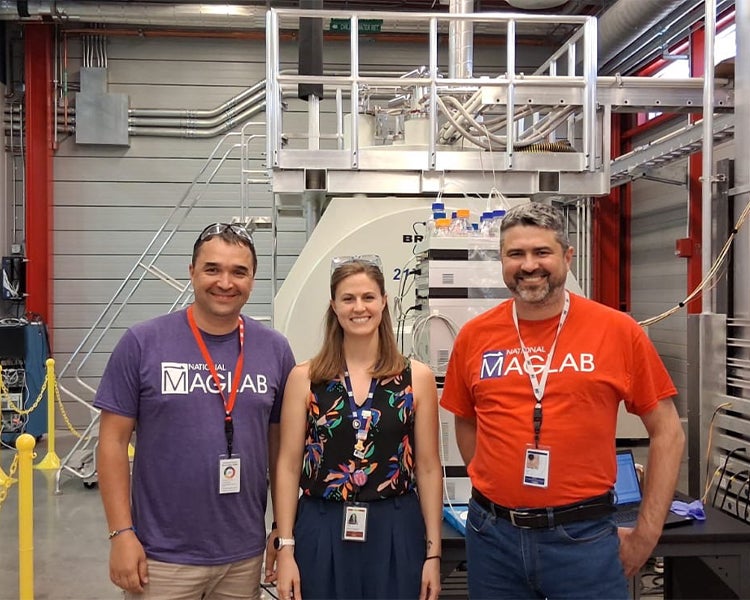
Mag Lab Research
Dr. Dmytro Diadin and Dr. Oleksandra Hrytstna worked in FSU's National High Magnetic Field Lab with Dr. Lydia Babcock-Adams and Dr. Ryan Rodgers (not pictured) from the Ion Cyclotron Resonance Facility.
“I see that we will have further cooperation on water quality and just in general water studies because in Florida you have really unique conditions of groundwater formation, groundwater pollution and groundwater use,” added Diadin. “In Ukraine we have different conditions but the impacts, the anthropogenic inputs to water and the necessity of water preservation, to ensure water quality, water safety. This is in our common tasks. So, I really see that we will cooperate on these water issues with the FSU.”
The BridgeUSA Ukraine Program for Resilience and Reconstruction is funded by the U.S. Embassy in Kyiv, with additional funding from U.S. host institutions, and is administered by American Councils for International Education. The program equips professionals with the skills and expertise needed to support Ukraine’s recovery and resilience.
“BridgeUSA provides an opportunity to meet face-to-face,” said Hrytstna. “It is important because you see your partner, your scientist colleagues and you have eye contact. In a face-to-face meeting, we can better understand each other. For me, it is a two-way bridge. It is not only the U.S. to Ukraine. It is also Ukraine to the U.S.”
ABOUT LSI
LSI strives to lead the way in creating innovative educational solutions that seamlessly connect theory with practice. Through advanced research, we develop industry-leading methods and implementation strategies to enhance systematic learning at all levels and in all environments. For more than five decades, LSI has been committed to driving measurable improvements in the performance of both individuals and organizations.