
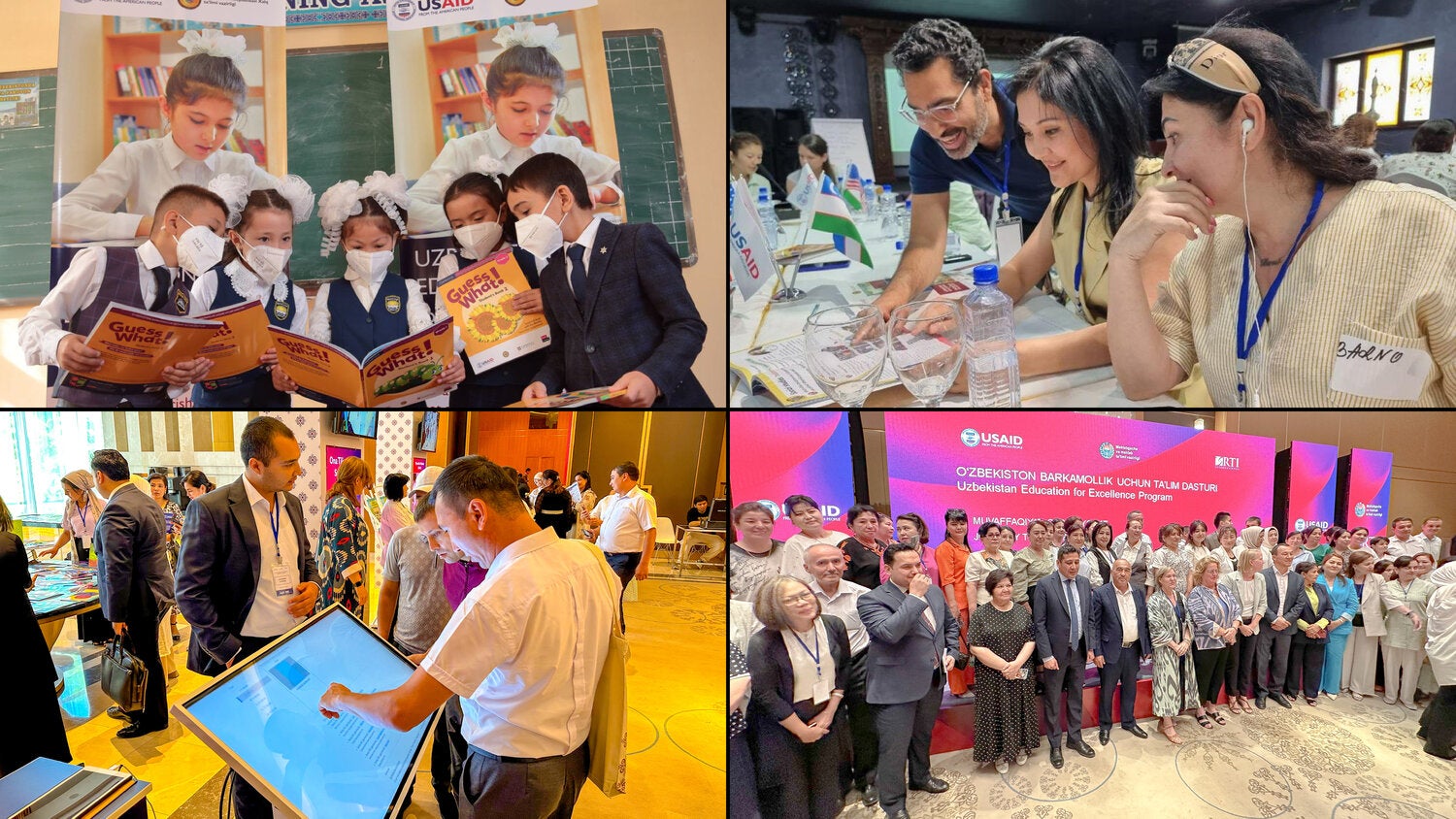
Uzbekistan Excellence for Education Program (UEEP)- Science, Technology, Innovation, and Partnerships (STIP) in Higher Education
Funding Partner: USAID Central Asia
Principal Investigator: Rabieh Razzouk
Co-Principal Investigator: Flavia Ramos-Mattousi
Project Announcement
February 25, 2020
The Uzbekistan Education Reform Program is a new initiative sponsored by the United States Agency for International Development under the Science, Technology, Innovation, and Partnerships (STIP) in Higher Education Annual Program Statement. RTI International and its partners, Florida State University and Mississippi State University will implement the four-year program from 2020 to 2024.
In the past fifty years, LSI has worked in 36 countries, but never in Uzbekistan. Uzbekistan gained independence from the Soviet Union in 1991. The country has a high literacy rate, with about 99 percent of adults above the age of 15 being able to read and write. Nevertheless, due to severe budget shortfalls in its education system this figure may decline, as only 76 percent of the under-15 population is currently enrolled in education. This situation gives rise to a growing interest on the part of the government and international donors to engage in partnerships for education.
In July 2019, Mr. Rabieh Razzouk (PI) and Dr. Flavia Ramos-Mattoussi (Co-PI) traveled to Tashkent, Uzbekistan representing LSI at FSU to participate in the ‘co-creation’ process. The one-week co-creation involved presentations by RTI International, MSU, and FSU followed by discussions with USAID, the Uzbek Ministry of Public Education and other stakeholders.
After a few months of deliberation, the Uzbekistan Education Reform Program was launched in February 2020. Again, the FSU representatives (Mr. Rabieh Razzouk and Dr. Flavia Ramos Mattoussi) traveled to Uzbekistan to participate in collaborative meetings with the Uzbek counterparts in Tashkent.
USAID is realigning and reorienting its policies, strategies, and program practices to improve how it supports each country on the Journey to Self-Reliance—or, put another way, a country’s ability to plan, finance, and implement solutions to address its own development challenges in a sustainable way. For the program, this means a focus on technical and managerial inputs that build MPE’s capacity to design and test, monitor, and learn from effective solutions. The Program will place added attention on using the lessons from pilot implementation to design sustainable scale-up strategies and plans, including identifying resource mobilization requirements.
The Ministry of Public Education (MPE) in Uzbekistan is committed to an ambitious program of systematic and comprehensive reforms. The country aims to create an education system that can produce graduates with the critical thinking, problem solving, and practical skills that will enable them to succeed. The United States Agency for International Development (USAID) has put in place an agreement with MPE for the Uzbekistan Education Reform Program. This program commits USAID to support the goal of sustainably improving the reading, math, information and communication technology (ICT), and English skills of students in the country’s public schools. Future students, therefore, will be more employable and/or more likely to gain acceptance into university studies. To attain the desired improvements in learning, MPE and USAID have agreed on a collaboration to achieve three components:
Component 1: Improve reading and math outcomes in grades 1–6
Component 2: Support IT Nation initiatives for grades 1–11
Component 3: Improve English language instruction
RTI International is collaborating with Mississippi State University (MSU) and Florida State University (FSU) to provide the expertise and experience needed to help MPE achieve and sustain the above results.
This Program description benefits from the insights and agreements obtained during the co- creation workshop held in Tashkent, July 22–26, 2019. MPE colleagues from all concerned technical departments attended the workshop sessions, actively assisting the RTI team in understanding the needs, opportunities, and challenges present in the education sector. As a result, the Program now aligns its activities more closely to MPE’s needs, including taking into account and complementing other projects and initiatives.
At the close of the co-creation workshop, Minister of Education Sherzod Shermatov reaffirmed the guiding principles of quality, justice, and transparency that govern the reform agenda in the education sector. A commitment to quality is reflected in the Program’s focus on helping Uzbekistan adopt best practice approaches to standards-based education and state-of-the-art teacher professional development strategies. The Program will also assist MPE in making sure resources and support enhance justice with developing and testing strategies that can be successful even in districts with fewer resources. In addition, the Program’s approach to instruction includes enabling teachers to focus on creating a welcoming environment by responding to the needs of male and female students, as well as supporting students who are struggling and extending opportunities for those who are advanced.
The rigorous frameworks for monitoring, evaluating, and sharing the lessons from project activities will support MPE’s commitment to transparency. This approach is consistent with USAID’s commitment to collaboration, learning, and adapting (CLA) as core principles of project management. Lastly, throughout the co-creation process, MPE emphasized the importance of capacity development as key to sustainability. The Program’s approach is therefore centered on helping MPE on its journey to self-reliance by developing the technical, managerial, and operational capacities needed for MPE to put in place a standards-based education system.
The FSU-Learning Systems Institute (LSI) team composed of technical experts in instructional design for the specific areas of the project (Math, Reading, and English) will provide technical assistance to the Uzbekistan Education Reform Program in collaboration with RTI International and the Ministry of Public Education in Uzbekistan. FSU-LSI will bring to the table many years of experience in international development, and most of all the experience of working with Florida teachers on the development of standard-driven instruction for K-12 students. In addition to the technical assistance to local partners, FSU-LSI intends to build the capacity of the MPE to develop and maintain its own web-based platform with resources to support teachers and students in grades 1-11 beyond the life of the project. Rabieh Razzouk, Director of CPALMS, initiated the ‘platform’ idea — an online toolbox of information, vetted resources, and interactive tools that helps educators effectively implement teaching standards. CPALMS is the State of Florida’s official source for standards information and course descriptions. https://www.cpalms.org
The vision is that teachers and students in Uzbekistan will have access to a variety of instructional resources and the ability to interact with those resources as well as with educators from around the world to address the learning needs of 21st century students.
2022 Update
Under the Uzbekistan Education for Excellence Program, funded by USAID, the LSI team provided training, facilitation, and guidance on the development of the new curriculum standards for math, Uzbek language arts, and English as a foreign language. In addition, the LSI team helped the ministry in evaluating, choosing, and customizing textbooks for teaching English as a second language. This is a significant transformation of the education system in the country that will have a very long-lasting effect. LSI led the development of a digital platform that will house all the curriculum standards, curricular materials, including textbooks and supplemental resources, and be used by all 300,000 teachers in Uzbekistan. Last year, the platform was launched for a pilot group of teachers, and the LSI team is currently training the ministry’s staff on the full version. This system will provide immediate and direct support to all the teachers in Uzbekistan to access materials made available to them by the ministry. This is an unprecedented effort in the country and will certainly bring in a lot of day-to-day support to all teachers by having a one-stop shop for all their curricular needs.
2023 Update
Under the Uzbekistan Education for Excellence Program funded by the U.S. Agency for International Development, the LSI team has provided training, facilitation, and guidance on developing new curriculum standards for math, Uzbek language arts, and English as a foreign language (EFL). In addition to developing EFL standards, the LSI team supported textbook selection and customized a series of student books, teacher books, and workbooks for EFL in grades 1-11. This involved making appropriate changes to the books and developing instructional videos to assist teachers in effectively using the new materials. Nationwide distribution of the series of English textbooks for all grade levels has been completed for the 2022-2023 school year. In 2023, the LSI team conducted a Status of Instruction study focusing on adopting the new English language teaching textbooks introduced in all public schools during the 2022-2023 academic year. Furthermore, the LSI team has led the development of an educational digital platform to house all curriculum standards and materials (including textbooks and supplemental resources) accessible to all 300,000 teachers in Uzbekistan. The platform was launched for a pilot group of teachers in 2022, and the LSI team trained the ministry’s staff on the full version in June 2023. This unprecedented effort will provide immediate and direct support to all teachers, enabling them to access materials made available by the ministry. This one-stop shop for all their curricular needs brings significant day-to-day support to teachers in Uzbekistan.
2024 Update
To support the Ministry of Public Education in achieving its reform agenda, USAID initiated the four-year, $29.5 million Uzbekistan Education for Excellence Program, which concluded in 2023. The LSI team provided training, facilitation, and guidance on the development of new curriculum standards for math, Uzbek language arts, and English as a foreign language. In addition, the LSI team helped the ministry in evaluating, choosing, and customizing textbooks for teaching English as a second language. LSI also led the development of a digital platform that houses all the curriculum standards and curricular Education for Excellence Program – Uzbekistan materials, including textbooks and supplemental resources, and can be used by all 300,000 teachers in Uzbekistan