
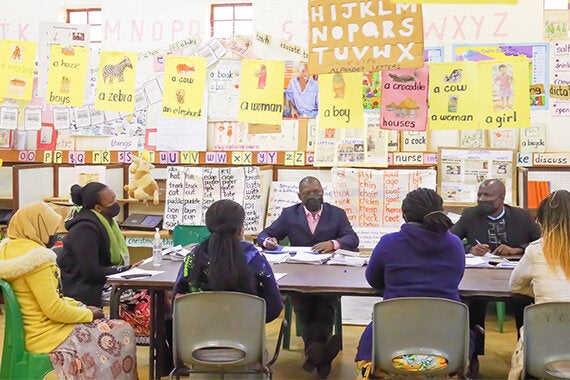
At the Learning Systems Institute (LSI) at Florida State University, we specialize in delivering rigorous, evidence-based evaluations that empower organizations to enhance educational outcomes in low-resource environments. With decades of experience assessing programs that address the learning needs of children, adults, and communities, LSI is a trusted partner for initiatives where education plays a pivotal role in building agricultural knowledge, workforce skills, and community resilience. Our evaluations provide actionable insights to optimize program design, implementation, and impact, ensuring sustainable improvements in education, food security, and economic development through targeted education interventions. Whether evaluating teacher training, education programs, or inclusive strategies, LSI’s process is tailored, collaborative, and focused on real-world applicability.
Why Partner with LSI?
LSI stands out for our commitment to equity, innovation, and impact. Our evaluations not only measure success but also build local capacity, ensuring programs achieve lasting results and community empowerment. With a track record of delivering on time, budget-conscious insights, we help contractors demonstrate value and refine strategies for maximum reach.
We look forward to discussing your project and innovating learning with you.
LSI's Evaluation Work
Florida Tax Credit Scholarship Program Evaluation
To expand educational opportunities for children of families that have limited financial resources and to enable children in this state to achieve a greater level of excellence in their education, the Florida Legislature created the Florida Tax Credit (FTC) Scholarship Program in 2001. The law provides for state tax credits for contributions to nonprofit scholarship funding organizations, (SFOs). The SFOs then award scholarships to eligible children.
LSI has been designated as the independent research organization responsible for conducting the annual evaluations of the FTC and FES programs. As part of this process, participating private schools submit students’ norm-referenced assessment score reports to LSI for program evaluation.
LSI has conducted the evaluation of the FES Program for the past five years. Similarly, LSI has conducted the evaluation of the FTC Program for the past 11 years.
During the 2025-2026 academic year, LSI is evaluating the FTC and FES programs for more than 180,000 students in grades 3 through 10 attending participating private schools.
Evaluating non-formal learning programs for out-of-school youth in northern Nigeria
In this study, which was conducted through a subcontract on the Northern Education Initiative Plus project funded by USAID Nigeria, we examined the association between attending a Non-Formal Learning Center (NLFC) in Sokoto and Bauchi states for at least nine months and reading outcomes for out-of-school children (OOSC) who entered formal schooling by grade 4. We used hierarchical linear modeling with data from 1,116 pupil Early Grade Reading Assessments (EGRA) and pupil surveys collected by the NEI Plus program. Overall, NFLC-mainstreamed pupils read at the same levels as their formally schooled peers, despite having had disruptions to their education. Given this evidence, we recommended that policymakers should consider maintaining the NFLCs to jumpstart OOSC into school.
Zambia Pre-Service Teacher Education Study (Gates Foundation)
This study examined the outcomes of Transforming Teacher Education in Zambia, a U.S. Agency for International Development activity (2020-2025) focusing on primary grade teacher preparation for foundational literacy. We compared student teachers trained in TTE-participating government colleges of education to student teachers from non-TTE-participating private colleges (N=305). Student teachers who attended TTE colleges had better knowledge of early grade reading and stronger performance in the classroom, including both literacy-specific and general pedagogy. The mean differences for the observation scores in controlled models were substantial—.861 standard deviations and .967 standard deviations, respectively. While this study design was not causal, the findings strongly suggest that a holistic, intensive intervention at colleges of education level can enhance the quality of new teachers’ knowledge and pedagogy. Future research will examine associations between student teachers’ training at TTE colleges and learner literacy outcomes in grades one through three.
Student perceptions of school safety and student learning outcomes in a context of protracted conflict
The data used in this analysis were collected in 2019 as part of a technical assistance collaboration FSU and UNICEF for the promotion of early grade reading in northeast Nigeria. In this study, we collected and analyzed quantitative survey and assessment data on 712 students in northeast Nigeria to examine, first, which students feel safe in school in a region experiencing protracted conflict, and second, how perceived safety was associated with literacy. Students with vision and hearing disabilities were less likely than other children to perceive themselves as safe at school. Children with these disabilities who felt unsafe performed nearly .8 standard deviations below other students, while students with disabilities who felt safe performed only slightly below others. We found no association between length of conflict-related school closures and literacy outcomes.